Orthoplastics
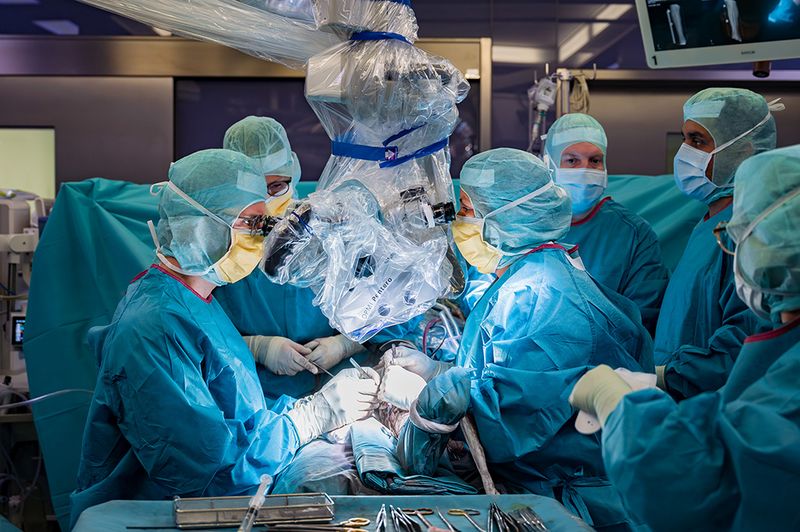
Orthoplastics – also known as reconstructive orthopedics – describes the interdisciplinary collaboration between orthopedics and plastic surgery. The aim is to treat complex injuries, infections and diseases of the arms, hands, legs and feet in order to restore function, mobility and quality of life as much as possible.
By combining modern orthopedic procedures with plastic surgery techniques, both bone and soft tissue defects can be reliably reconstructed.
The central aim of orthoplastic surgery is to restore the function, form and mobility of the affected limb as much as possible. At Balgrist University Hospital, we offer the entire spectrum of highly specialized reconstructive procedures. In the case of serious injuries, infections or tumors in particular, orthoplastic reconstruction can not only ensure the preservation of the extremities, it can also preserve patients’ long-term mobility, independence and quality of life. Each treatment is individually tailored to the specific requirements and complexity of the respective clinical picture and to the needs of the patient.
Orthoplastics Unit at Balgrist University Hospital
The Orthoplastics Unit (PD Dr. med. D. Kaiser, PD Dr. med. A. Hasler, Dr. med. L. Estermann) at Balgrist University Hospital consists of a specialized interdisciplinary team with proven expertise in the reconstruction of complex injuries and defects. The team members have undergone comprehensive national and international training and have many years of clinical experience in their respective fields.
Thanks to the close and structured collaboration with the experts in the highly specialized orthopedics department at Balgrist University Hospital, care of the highest medical standard is guaranteed.
Range of procedures
Orthoplastic surgery (orthoplastics) encompasses a wide range of surgical and microsurgical reconstructive procedures. The aim of any limb reconstruction is to restore the function of the affected limb in a way that it is clearly superior or, at least, equivalent to an amputation with subsequent use of a prosthesis.
Reconstructive surgery after trauma, tumor or infection
Reconstructive procedures are performed to restore form and function:
- After tumor resections
- After serious accidents and traumas (compley musculoskeletal system defects)
- In cases of infection (acute and chronic)
- In cases of complications after orthopedic procedures, in particular therapy-refractory pseudoarthrosis (failure of a bone to heal after fracture or arthrodesis) and infections
- In cases of avascular necrosis (i.e. lack of food supply to the bone)
- In cases of non-healing wounds, e.g. in the context of diabetic foot syndrome
Reconstructive procedures
Skin and tissue transfers:
- Dermal substitution procedures (skin graft, full-thickness skin substitute, synthetic substitution procedures, etc.
- Local fascial cutaneous and muscle flaps (perforator flaps, gastrocnemius flaps, anconeus flaps, etc.)
- Free microsurgical flaps (e.g. latissimus dorsi muscle flap, gracilis muscle flap, an-terolateral thigh (ALT) flap, etc.)
- Vascularized bone transfers (medial femoral condyle (MFC) flap, free vascularized fibula, etc.)
Neurosurgery after amputations
The Orthoplastics Unit, in collaboration with the Hand Surgery and Peripheral Neurosurgery team, offers state-of-the-art neurosurgical procedures for the treatment and prevention of neuroma and phantom pain, for example after amputations. Procedures such as targeted muscle reinnervation (TMR) and regenerative peripheral nerve interfaces (RPNI) are used for this.